Contact Us

Use the form on the right to contact us.

You can edit the text in this area, and change where the contact form on the right submits to, by entering edit mode using the modes on the bottom right. 


123 Street Avenue, City Town, 99999

(123) 555-6789

email@address.com


You can set your address, phone number, email and site description in the settings tab.
Link to read me page with more information.

Archive

Filtering by Category: Sudan

Urgent Concern about new UK Visa Policy for Sudanese Students

SSSUK Committee

We write to express our concern and dismay about the Government's statement of 4 March 2026. The statement declared that visas will not be issued for students from Afghanistan, Cameroon, Myanmar and Sudan, on account of what it calls widespread abuse, namely students from these countries lodging asylum claims.

The UK and Sudan have a long and deep, mutually beneficial history of educational ties and exchange, dating back to colonial times. Maintaining this relationship could not be more important than in the present circumstances. The war that erupted in Sudan almost three years ago has devastated the country's education sector. Millions of Sudanese children, youth, and young people are facing an uncertain educational future, making them and the country ill-prepared for the task of post-conflict reconstruction to come.[1] Offering British education for Sudanese students, rather than cutting it off, should therefore be a policy imperative at a time of utmost need.

Doing so aligns with the FCDO's stated commitment to assist the people of Sudan. As the UN Security Council penholder on Sudan, the UK's conduct carries considerable weight. Effectively banning students from studying in the UK sends the wrong message, to the Sudanese and to the world at large, on how the UK responds to the war and views the Sudanese people. It is a discriminatory and disproportionate response to the 120 Sudanese students who reportedly claimed asylum last year, up from 90 the year before, out of over 4 million Sudanese refugees worldwide.[2]

Many Sudanese students are recipients of scholarships which demonstrates their potential. They and their families frequently have to make considerable sacrifices to enable them to study in the UK, which Sudanese still value as a destination for higher education. Seeing letters that are circulating in which applications by Sudanese students for Chevening Scholarships have been terminated following the announcement is heartbreaking and unconscionable. It runs contrary to the spirit of the programme which is intended "to enable outstanding emerging leaders [and to] build lasting positive relationships with the UK".[3]

SSSUK therefore calls on the UK government to lift the visa ban for Sudanese students. At the very least, it should provide visas for students on schemes like Chevening and university scholarships. SSSUK also urges the Government to take proactive steps to enable young Sudanese to exercise their right to education, to prepare themselves for the future challenges their country faces, and to contribute to maintaining and strengthening the long-standing relationship between the two countries and its peoples in the field of education.

SSSUK Committee

7 March 2026

enquiries@sssuk.org

The Society for the Studies of the Sudans UK (SSSUK) is a UK registered charity that promotes the study and understanding of South Sudan and Sudan in all their aspects, serving as an important forum for exchange and learning between the UK and the Sudans.

[1] 'Case Study: Current Education Situation in Sudan', ERICC Helpdesk report by Rebecca Glade and Ahmed MS Elbashir, May 2025 (accessed 6 March 2026); and ' Universities under siege: The impact of the Sudanese war on the sustainability of higher education in Sudan', by Mohd Elmagzoub Eltahir, Osman Sirajeldeen Ahmed, Asma Sirageldin Ahmed, Emad Eldin Omer, Journal of Adult and Continuing Education, 16 October 2025 (accessed 6 March 2026).

[2] Figures on the numbers of Sudanese Study Visa holders making applications for asylum are taken from Home Office press pack 'Notes to editors', 3 March 2026, accessible online on Politics UK. 'Sudan Regional Refugee Response Plan 2026 - At a Glance', available on the UNHCR Operational Data Portal (accessed, 6 March 2026).

[3] Chevening, the UK government’s international scholarships and fellowships programme, Scholarships website page (accessed, 6 March 2026).
Showing of the film 'Khartoum', 14 February 2026 - with review

SSSUK Secretary

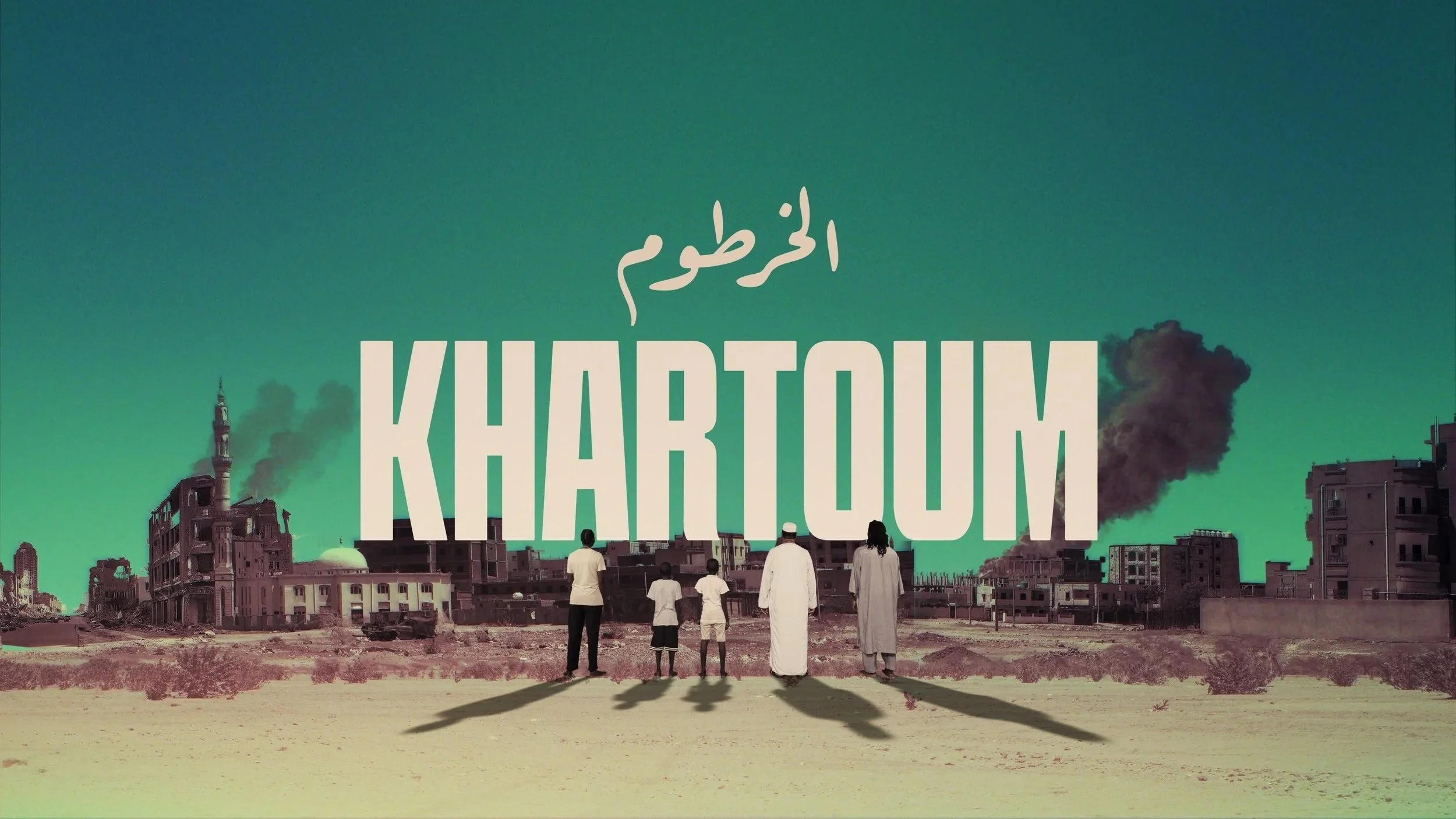
Promotional poster for the 2026 film 'Khartoum' depicting 3 adults and 2 children watching Khartoum burn in the distance.

Join us in person to watch this award-winning film, followed by a discussion. Money raised above costs will be donated to HAS. 

The showing will take place at the Lucas Lecture Theatre at King's College London on Saturday 14 February at 4pm. Please arrive on time.

Khartoum: five lives, one city, a nation at war

Native Voice Films & Sudan Film Factory with BBC Storyville, GISA Productions, Ayin Network, XTR

A civil servant, a tea lady, a resistance committee volunteer and two street boys. Five stories from Sudan weave together in search of freedom through animated dreams, street revolutions and a war from the metropolis of Khartoum to escape in East Africa.

A film by Anas Saeed Rawia Alhag Ibrahim Snoopy Timeea M. Ahmed with Yousef Jubeh & Phil Cox.

In 2022, four Sudanese filmmakers and a British writer-director began filming the everyday lives and dreams of five very different residents of Khartoum. Street boys Lokain and Wilson scour a garbage dump so they can buy two beautiful shirts; tea seller and single mother Khadmallah diligently studies maths so she can start her own business; Resistance Committee volunteer Jawad protests against the military regime; civil servant Majdi escapes office life by racing pigeons with his son. When filming begins, they are all living under a military regime that had recently overthrown the civilian government in Sudan. A short time later, the regime splits and a war begins between the military and the Rapid Support Forces militias that displaces more than ten million people. The filmmakers and their protagonists, too, are forced to flee to East Africa. Using animation, green screen reconstructions and dream sequences, they find alternative ways to tell their stories. The result is an emotional, lyrical portrait of five people from Khartoum at a key moment in African history.

Where : Lucas Lecture Theatre, Strand Building, King's College London WC2R 2LS 

When : Saturday 14 February at 4pm

Price : Tickets are £10 and are available on Eventbrite

SSSUK would like to thank Almas Art Foundation and King's College London and its volunteers for their help supporting this event. The showing is a part of Almas Art Foundation’s Voices and Visions of Sudan film programme.

Download the flyer

Review

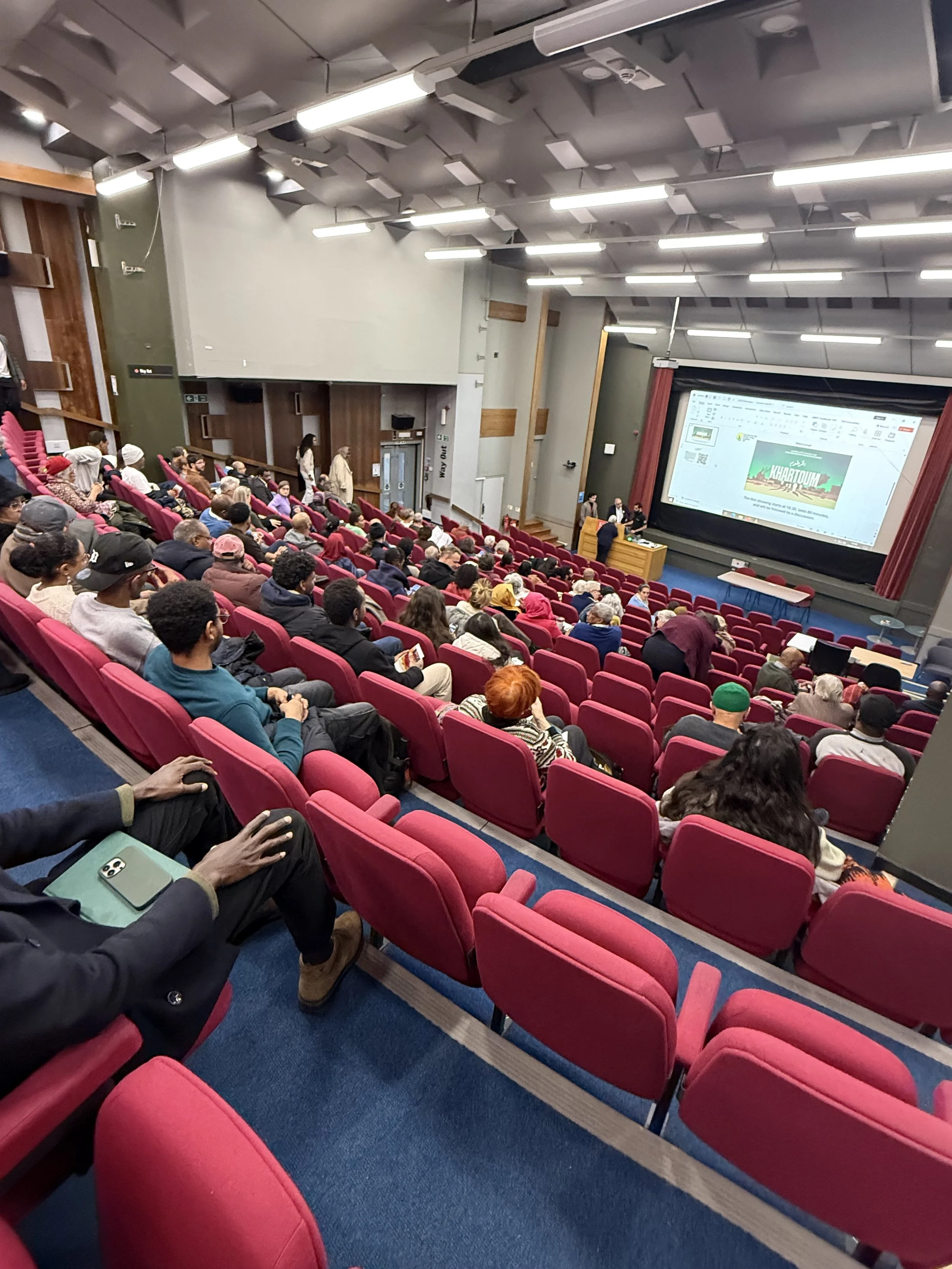
SSSUK was proud to host a showing of the film 'Khartoum' at King's College London on Saturday 14 February. SSSUK would like to thank Almas Art Foundation and King's College London and its volunteers for their help supporting this event. The showing was a part of Almas Art Foundation’s BFI and National Lottery-supported Voices and Visions of Sudan film programme. There's a short survey the British Film Institute would like people who attended to complete so they can extend these kinds of programming.

The film and a short video piece by co-Director Ibrahim Snoopy were followed by a general discussion, led by Chairperson Aziz Magid. Guest speakers also said a few words - Marilyn Deegan, about the Sudan Memory project, and Giel Malual, about his and John Kuei's Long walk of freedom for Sudan, funding education for refugees fleeing the war. 

The audience seated in a lecture theatre at King's College London during the showing of the 2026 film 'Khartoum'.

Comments after the film included: "I thought it was brilliant in its apparent simplicity ... the way it depicted the heartfelt truths of the people in it ... I was absolutely blown away by the effects. Uncomplicated but so deeply affecting and powerful. Amazing!"; "I especially valued that the film presented real facts about the war in Sudan".

Costs having been deducted, £1,245.92 was raised from ticket sales and donations through Eventbrite. This has been donated to Humanitarian Action for Sudan. Such a sum will fund around 1,500 food baskets (lentils, sugar, oil) which HAS help provide in multiple places across the country, including Darfur, Kordofan or East Sudan. You can read HAS' information on its activities here. Congratulations to all who purchased a ticket and made a donation! 

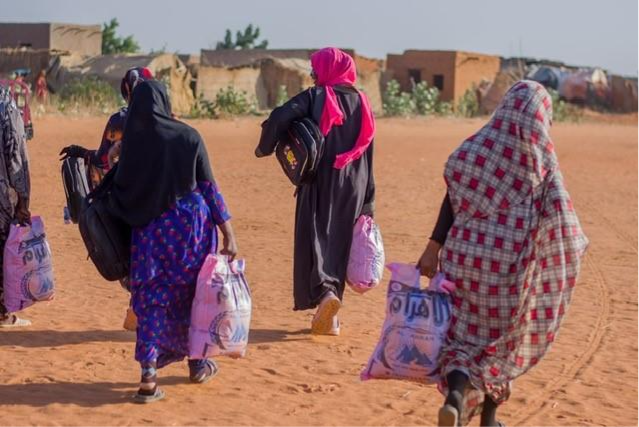
Sudanese women disperse from a HAS aid point carrying sacks of food and other items.

More events are being planned by the SSSUK Committee and members and we'll be in touch with more details soon.

Second statement on the war in Sudan

SSSUK Committee

Readers will need no reminder that the war has now been raging in Sudan for two years. Like many we made a plea at Eid two years ago that the combatants draw back from disaster and end the war. This Eid, with great sadness, we urgently repeat our plea. Those risks we identified in 2023 - of countless lives lost, of critical infrastructure destroyed and heritage institutions damaged and looted - all these have come to pass in almost every region of the country. The war is also now destabilising neighbouring countries, such as South Sudan, millions have been displaced from their homes, a growing famine threatens further devastation, and a generation's education and promise of a fulfilling future is at risk.

What we could not fully anticipate in 2023 was the resilience and bravery of extraordinary ordinary civilians in communities across the country who have taken on the duties of responsibilities of the state themselves, feeding the hungry, healing the wounded and the sick, and teaching the children. We pay tribute to all those working and sacrificing for others amidst all the danger and destruction and equally underscore the need for their protection from harm. Together they represent a precious victory for humanity that will be remembered for generations.

SSSUK is a non-governmental charitable organisation with a Sudanese, South Sudanese and international membership; our members seek to make the history and culture of Sudan and South Sudan better known and understood. Our Society continues to stand back from engagement in politics, but we again take this moment of Eid to encourage belligerents to pause and look for political solutions; only these will end this war and create a sustainable peace. Recent developments on the ground seem to trend toward more clearly demarcated zones of military control. A resultant breathing space from the fighting may ensue, and in which case we strongly urge each side to seize the moment to engage with the civilian organisations who have sustained Sudan’s citizens through the long war, and set out a pathway towards civilian rule that offers hope to a nation and its friends abroad. 

Sudan has a rich history and diverse and resilient cultural traditions that have and can again sustain peace in disturbed times. As we celebrate Eid we ask you to pray for peacemakers and for peace.

Eid Mubarak.

SSSUK members visit the British Museum

Professor Heather J. Sharkey

On Wednesday 19 February 2025, thirteen members of the Society were treated to a tour of the British Museum’s Sudanese collections by Dr Zoe Cormack, Curator (Africa), and Dr Loretta Kilroe, Project Curator (Sudan and Nubia). Our two knowledgeable and gracious hosts brought members to library and collections rooms where they were able to examine Nubian, South Sudanese and Darfurian materials that are not on public display.

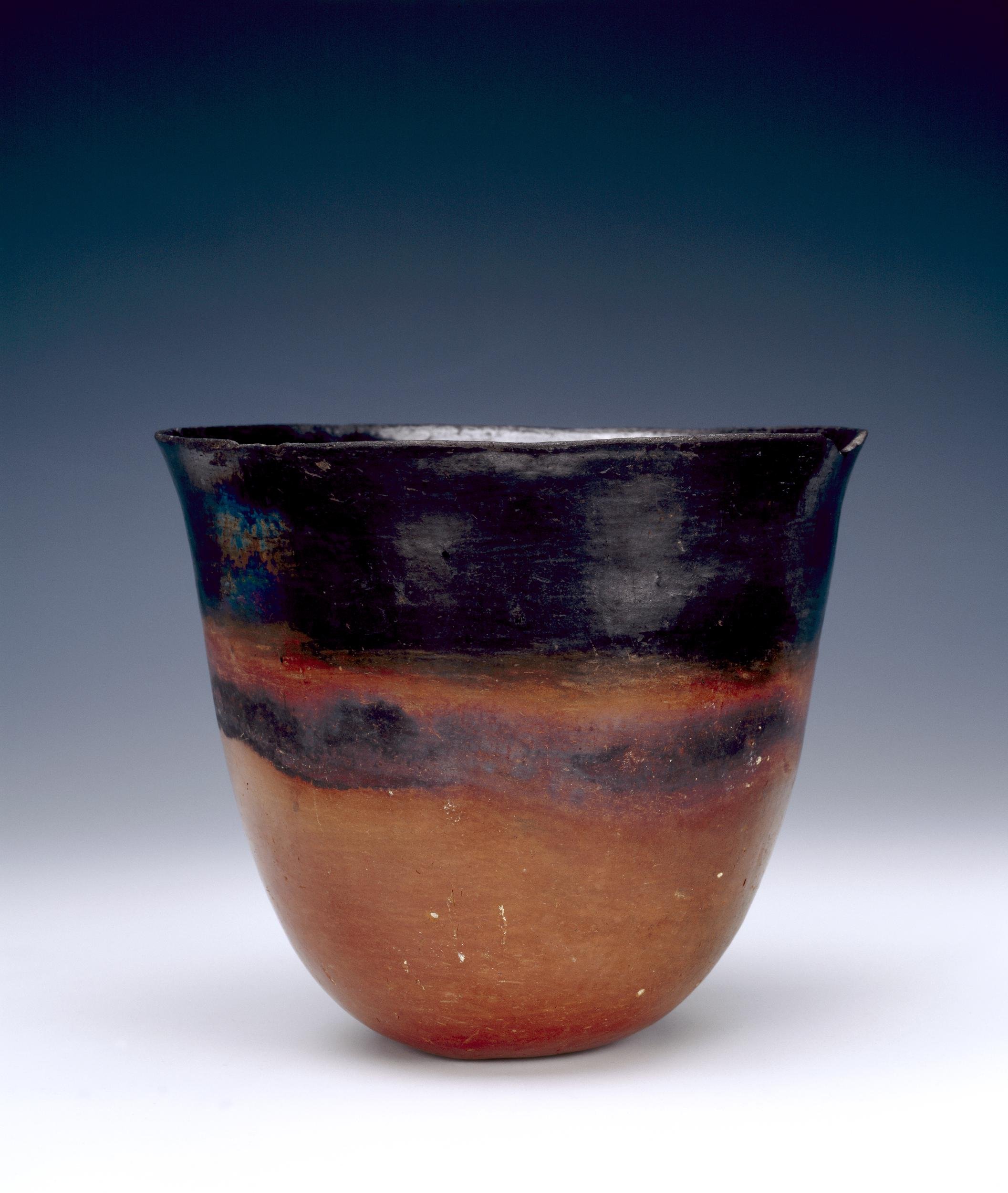
A stunning example of what they showed us was a Kerma beaker made of smoke-fired clay around 1500 BC and excavated near Dongola.

Kerma ware pottery jar, black-topped with everted rim, 1750BC-1450BC (Classic Kerma period) (EA55426) © The Trustees of the British Museum. Shared under a Creative Commons Attribution-NonCommercial-ShareAlike 4.0 International (CC BY-NC-SA 4.0) licence.

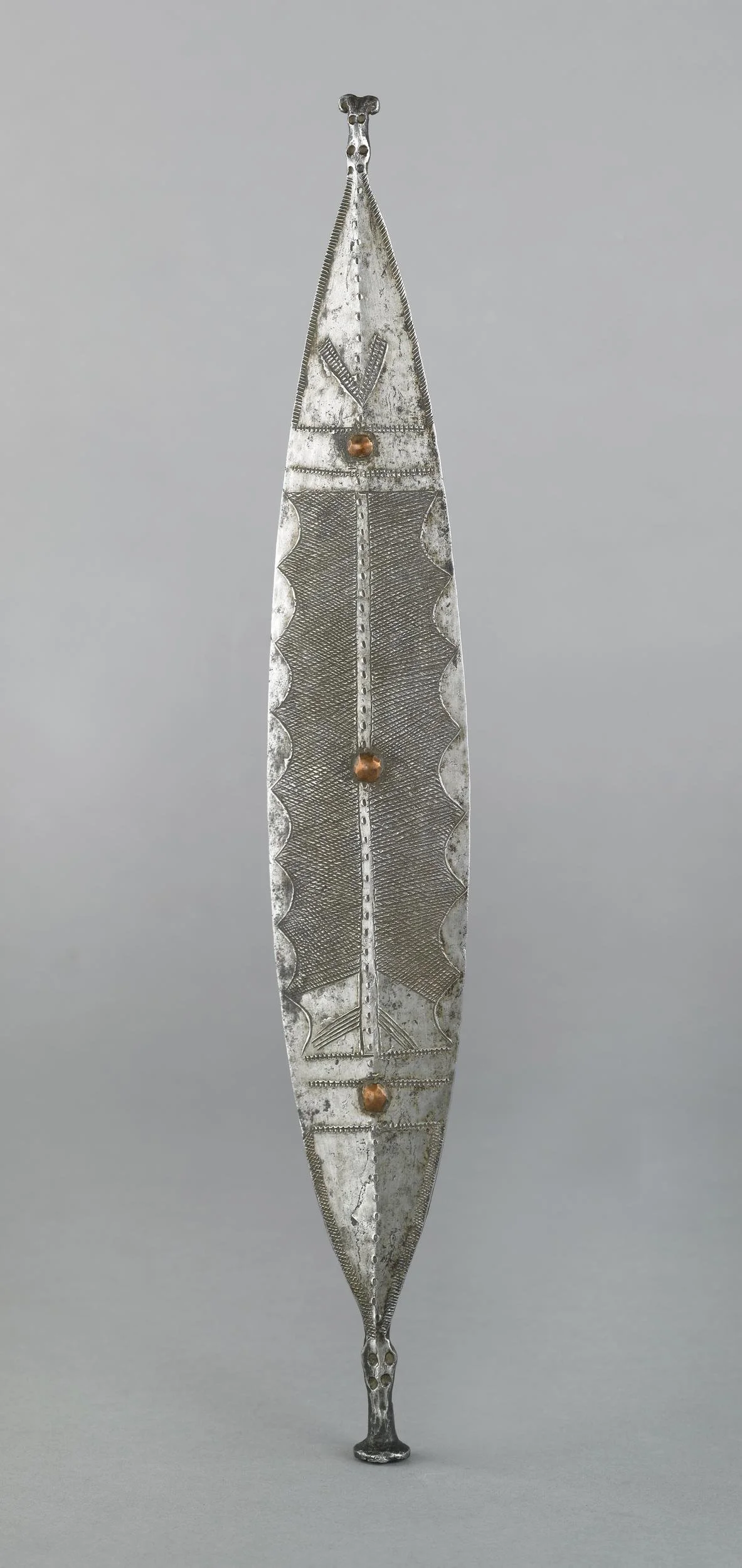
Another exquisite item was made by the Azande at some time before 1867: a leaf-shaped, delicately incised woman's iron and copper knife, intended to be worn on the arm.

Silver and copper leaf-shaped women's arm knife, standing vertically

Woman's knife worn on arm, currency (?) made of iron, copper, 1867 (or earlier) (Af.4460) © The Trustees of the British Museum. Shared under a Creative Commons Attribution-NonCommercial-ShareAlike 4.0 International (CC BY-NC-SA 4.0) licence.

Some of the most interesting materials were not necessarily the most beautiful or interesting to look at; only when one knows their purpose and backstory can one appreciate their significance. For example, Zoe showed the group what she called one of her own favourite objects from South Sudan: a divination stone or rainmaking pebble, made by the Bari people some time before 1905.

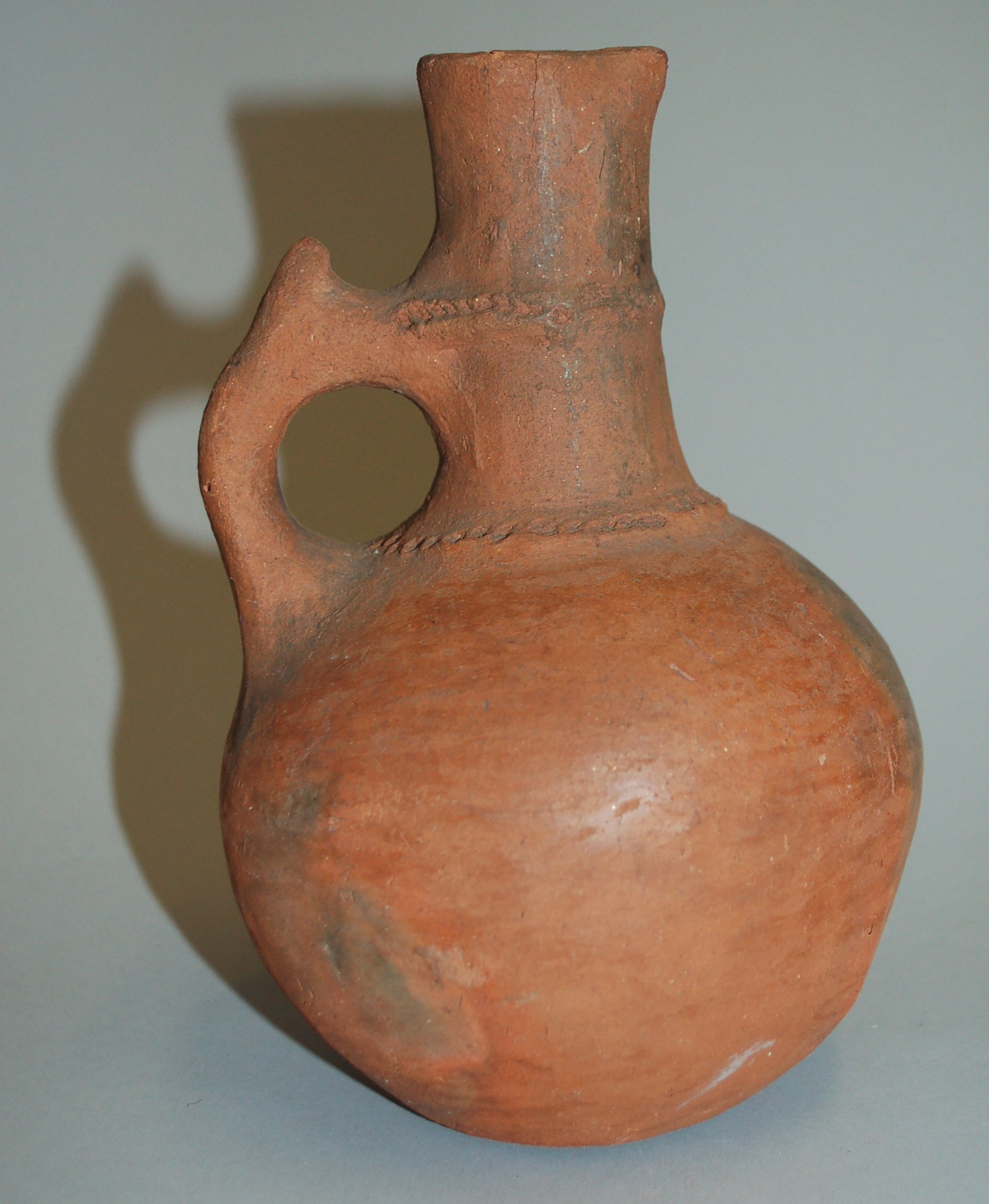
Other humble, everyday objects included a clay coffeepot or jubbana from northern Sudan, dating from the mid-nineteenth century — one of many such coffeepots in the British Museum’s collections.

Coffee pot with handle; made of red earthenware. Incised decorations around the neck, 1867 (or earlier) (Af.4432) © The Trustees of the British Museum. Shared under a Creative Commons Attribution-NonCommercial-ShareAlike 4.0 International (CC BY-NC-SA 4.0) licence.

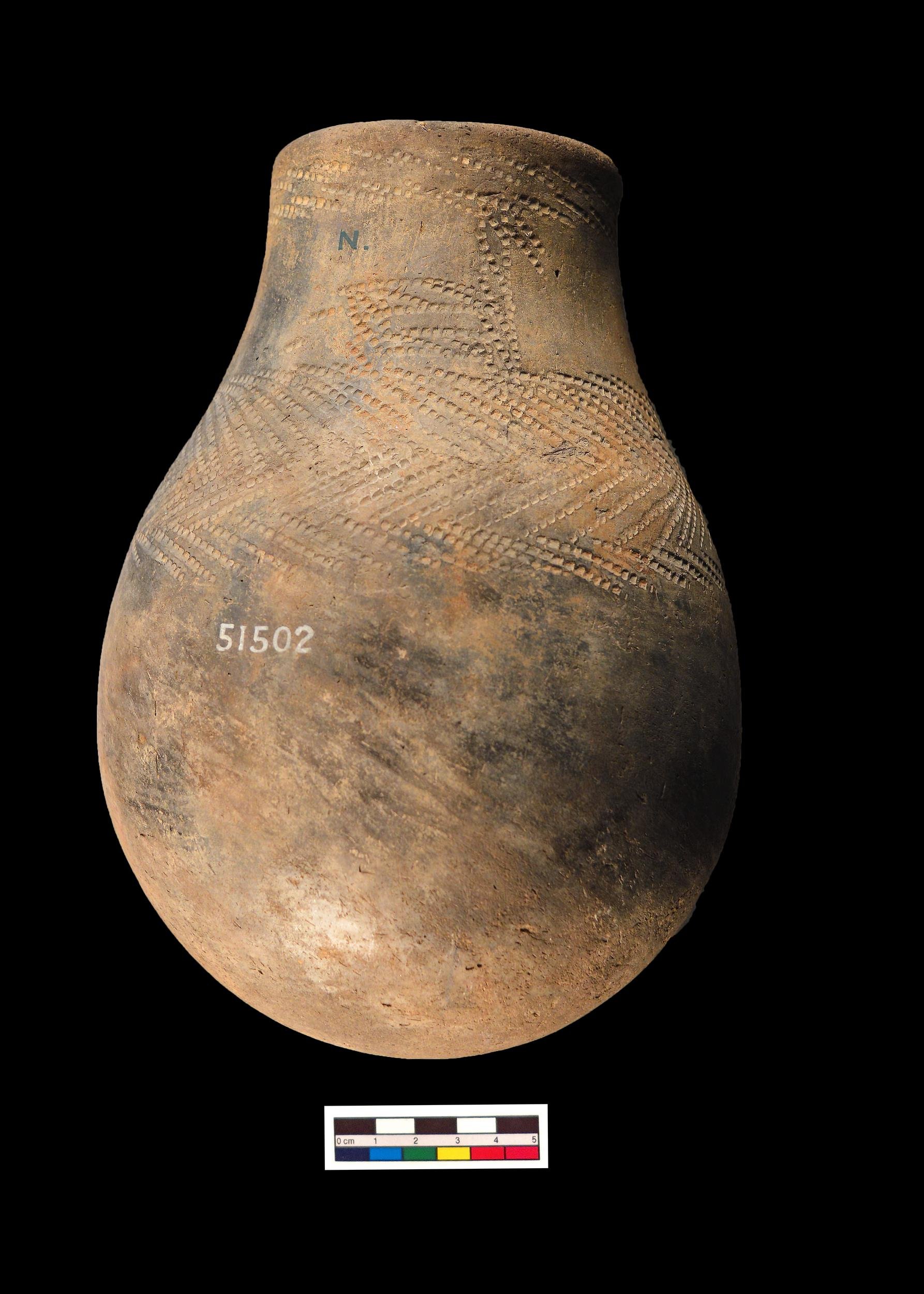
Loretta explained the significance of a striking Meroitic pot, from the kingdom of Kush (c.570 BC–AD550), which has a pattern of giraffes incised in the clay. She recently published an article about such giraffe motifs in the Journal of African Archaeology. Since giraffe imagery does not seem to have been prevalent in the “high” or elite culture of ancient Egypt and Nubia, she suggests that this pot and others like it may have reflected a popular religious culture that prevailed among Kushite women especially.

Black burnished jar from Faras with impressed giraffe decoration, c.570 BC–AD 550 (Meroitic) (EA51502) © The Trustees of the British Museum. Shared under a Creative Commons Attribution-NonCommercial-ShareAlike 4.0 International (CC BY-NC-SA 4.0) licence.

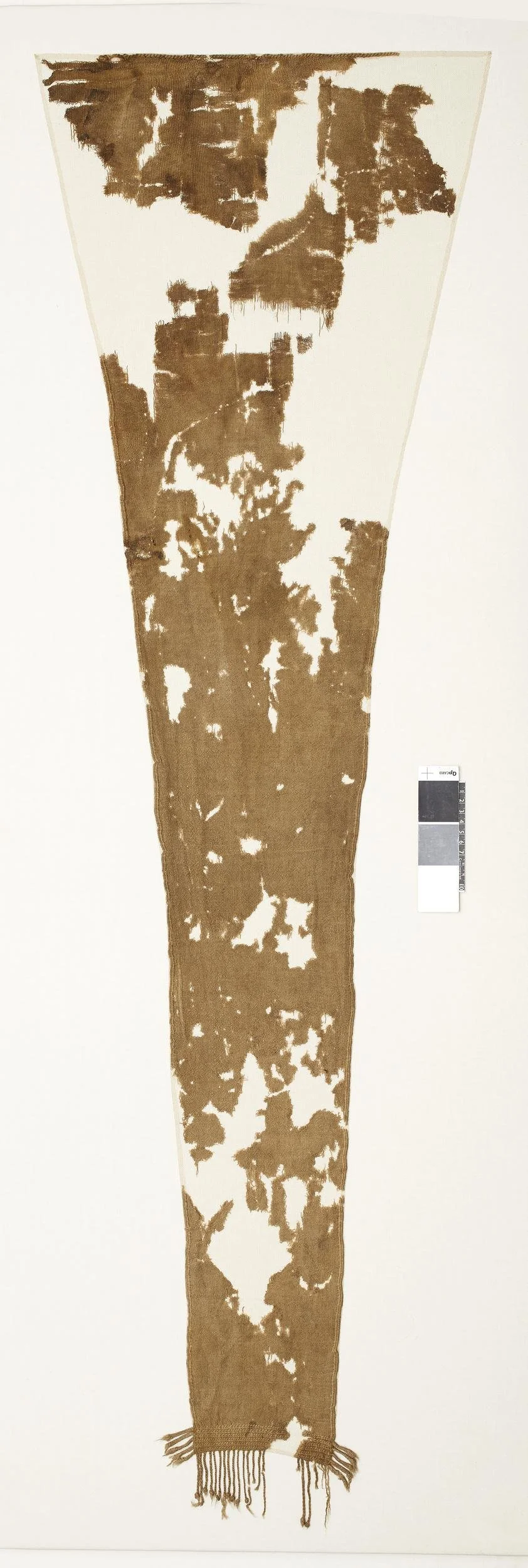
Also displayed was a woollen loin-cloth dating from between 600 and 850 CE and excavated from a burial at Kulubnarti, an island in the Nile about 100 miles south of the Egyptian border. In that period, the Nubian community at Kulubnarti was part of the Christian kingdom of Makuria.

Fragmentary woollen loin cloth from Kulubnarti, Sudan, 7th-9th century

Woven loin-cloth made of natural undyed wool, light tan in colour, excavated at Kulubnarti, Sudan, 600 × 950 CE (Early Christian Period). Originally, this was a fine garment with very even spinning and weaving. (EA77321) © The Trustees of the British Museum. Shared under a Creative Commons Attribution-NonCommercial-ShareAlike 4.0 International (CC BY-NC-SA 4.0) licence.

Several visitors later spoke about how inspiring the day was: “Brilliant! I came away energized and bursting with ideas;” “very interesting and useful”. We send our deep thanks to Loretta and to Zoe for giving so much of their time and expertise during the visit.

We hope to be arranging more such visits to Sudanese collections for members so please keep an ear out for any new updates.

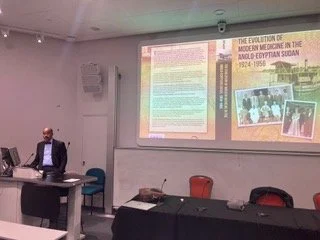
'The Evolution of Modern Medicine in the Anglo-Egyptian Sudan 1924-1956', by Dr Tarik Elhadd

SSSUK Secretary

A full recording of the event at the School of Oriental and African Studies (SOAS), where Dr Tarik Elhadd's book was launched, on 9 December 2023.

Dr Elhadd’s book is about the evolution of modern medical practices in the Sudan including curative medicine, public health, medical research, and education. It covers an important era from 1924, when the first medical school in the country was inaugurated, up until the Independence of Sudan in 1956. The Sudan, known during this period as the Anglo-Egyptian Sudan was not officially a British colony. The British came during zenith of the 'Great Scramble for Africa' and Kitchener's appeal for the Gordon Memorial College set the platform for modern education in the Sudan, and following his demise, his call to establish a medical school in the country was heeded. The medical school inaugurated in 1924 became the third of its kind in Africa, which helped the mesh of expanding the service to remote parts of the country. The author and translator of more than seven books on the history of Sudanese medicine walks us through a comprehensive and authoritative description of the formative years of the Kitchener School of Medicine, events, dates, progress, and role in the foundation of almost all healthcare institutions. In addition, the book analyses the evolution of Sudan's medical services, teaching, training, and research. - Professor Ahmed El Safi, Sudan Medical Heritage Foundation

From Christian missionaries working within the colonial project of civilizing the natives, to the training of doctors, nurses and midwives who came after them, the author, a medical doctor himself, offers a coherent narrative supported by detailed historical events, and punctuated by gripping life histories of both pioneer European and Sudanese doctors.

Dr Tarik Elhadd delivering his presentation at the launch of his book 'The Evolution of Modern Medicine in the Anglo-Egyptian Sudan 1924-1956'

Statement on the war in Sudan

SSSUK Committee

The Society for the Study of the Sudans UK (SSSUK) notes with sadness and alarm the ongoing extreme violence in Sudan, where infighting between military factions has caused the death of many innocent civilians and threatens the destruction of the cultural heritage and institutions throughout the country, including desperately needed healthcare facilities.

SSSUK is a non-governmental charitable organisation with a Sudanese, South Sudanese and international membership; our members seek to make the history and rich culture of Sudan and South Sudan better known and understood.

Our Society stands back from engagement in politics, but the combatants’ complete disregard for the lives and property of civilians across Sudan and the real threat of the war spreading further demand a concerted international response. Therefore, we join the United Nations and peaceful Sudanese people around the world in calling for an immediate ceasefire to enable a return to civilian government of the country. This is a time to unite to remember all that is good about Sudan and to hope, work and pray for a better future.

Eid Mubarak.

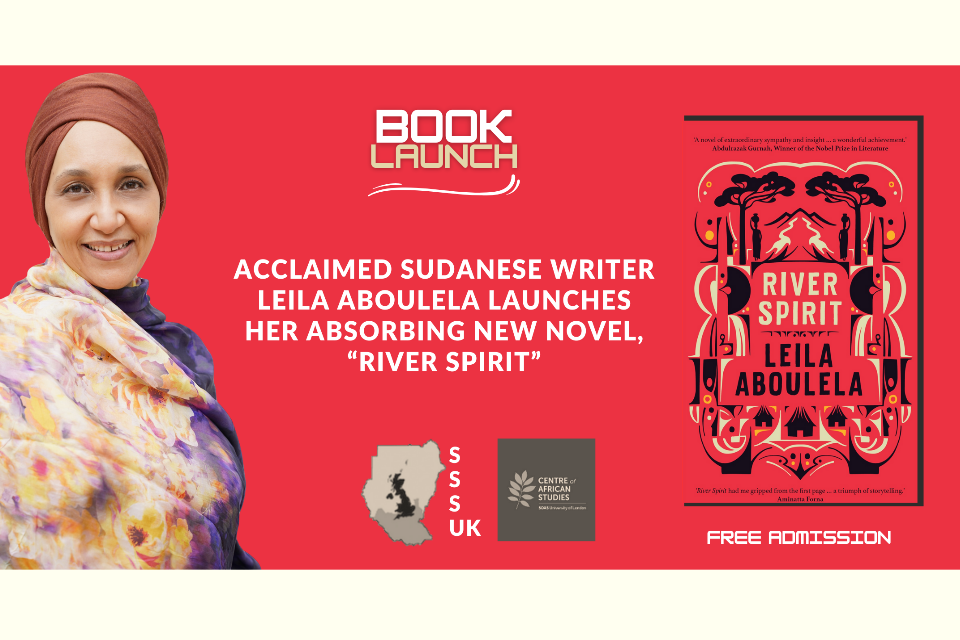
'River Spirit', by Leila Aboulela. Book launch, with Lutz Oette and Fergus Nicoll

SSSUK Secretary

Monday, 5.00-6.30 on 6 March 2023 at DLT, Main Building, SOAS. Free admission.

Leila Aboulela, hailed as “a versatile prose stylist” (New York Times) has also been praised by J.M. Coetzee, Ali Smith, and Ben Okri, among others, for her rich and nuanced novels depicting Islamic spiritual and political life. Her new novel is an enchanting narrative of the years leading up to the British conquest of Sudan in 1898, and a deeply human look at the tensions between Britain and Sudan, Christianity and Islam, colonizer and colonized. In River Spirit, Aboulela gives us the unforgettable story of a people who - against the odds and for a brief time - gained independence from foreign rule through their willpower, subterfuge, and sacrifice.

When Akuany and her brother Bol are orphaned in a village raid in South Sudan, they’re taken in by a young merchant Yaseen who promises to care for them, a vow that tethers him to Akuany through their adulthood. As a revolutionary leader rises to power - the self-proclaimed Mahdi, prophesied redeemer of Islam - Sudan begins to slip from the grasp of Ottoman rule, and everyone must choose a side. A scholar of the Qur’an, Yaseen feels beholden to stand against this false Mahdi, even as his choice splinters his family. Meanwhile, Akuany moves through her young adulthood and across the country alone, sold and traded from house to house, with Yaseen as her inconsistent lifeline. Everything each of them is striving for - love, freedom, safety – is all on the line in the fight for Sudan.

Through the voices of seven men and women whose fates grow inextricably linked, Aboulela’s latest novel illuminates a fraught and bloody reckoning with the history of a people caught in the crosshairs of imperialism. River Spirit is a powerful tale of corruption, coming of age, and unshakeable devotion – to a cause, to one’s faith, and to the people who become family.

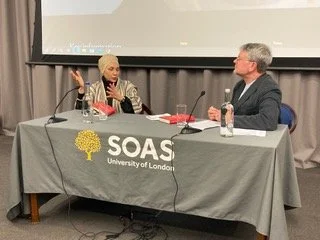
Leila Aboulela and Fergus Nicoll at the launch of 'River Spirit'

The SSSUK Symposium 2019: a video record

SSSUK Secretary

SSSUK's 2019 Annual Symposium took place on 7th September in the Brunei Lecture Theatre, at SOAS, London. Many of the presentations were about the 19th December revolution in Sudan. Here are video recordings. (Video by Moniem Ibrahim.)

Welcome from the SSSUK Chairperson, Gill Lusk.

The role of the Sudanese diaspora in UK in the 19th December revolution: reflections, challenges and the way forward.  Dr Amira Osman, Research Fellow, University College London; Sudanese Women’s Union UK and Ireland. Introduced by Charlotte Martin, Editor of Sudan Studies.

Panel:

Health

Chaired by Dr Rebecca Bradshaw, Archaeologist, Member of SSSUK Committee

Health outbreaks in Sudan: social injustice that led to political change. 

Dr Sara Ibrahim Abdelgalil, consultant paediatrician; President, Sudan Doctors' Union (SDU) UK; UK Spokesperson, Sudan Professionals' Association (SPA).

Silence in Blue: Campaign against sexual violence used in Sudan to crack down on women’s resistance. 

Dr Sara Beleil, consultant psychiatrist; SDU UK Academic Secretary.

Sudan revolution art: a project by the SDU UK to promote healing after the Khartoum massacre. 

Dr Nada Kamal: consultant microbiologist; Deputy Academic Secretary, SDU UK.

Panel:

The state of higher education in Sudan post-30 June 1989

Chaired by Dr Fergus Nicoll, Mahdiya historian and BBC World Service

The state of higher education in Sudan post-30 June 1989.

Selma Elrayah (Masters in Life Long Learning, London University; worked in London public libraries for over 20 years).

The state of higher education in Sudan post-30 June 1989.

Asim Salem, Committee, Khartoum University Alumni Association UK.

Introduction of SSSUK's new President, the novelist Leila Aboulela.

Sudanese women's aspirations and challenges for effective political participation.

Dr Suad Musa, PhD Peace Studies, Bradford University, researcher and activist in development and gender. Chair: Mawan Muortat, South Sudan political analyst; SSSUK Deputy Chairperson.

Panel:

Politics

Chaired by Gill Lusk, SSSUK Chairperson, writer on Sudan.

Challenges facing the new transitional government.

Dr Rosalind Marsden.

Sudan's future: The rationale and regulation of militias and the political process.

Dr Mohamed Elansari Ali, Head of UK Chapter, National Umma Party; Head of Foreign Affairs, Sudan Call UK office.

The Sudanese revolution: The way forward. 

Rashid Sidahmed Elsheikh: Political Activist, Sudanese Communist Party; researcher in Cultural Policy; Poet.

A Perspective from the diaspora.

Afia Abusham, British-Sudanese actress recently returned from Sudan.

The revolution will be televised, versified, sung, chanted, worn and painted: art as mobilisation in the 2019 Sudanese revolution.

Dr James Dickins, English teacher, Sudan, 1980-82; Professor of Arabic, Leeds University.

Introduced by Dr Abdel Azim El-Hassan, journalist, economist, SSSUK Committee.

Return of Carlo Acefalo

SSSUK Secretary

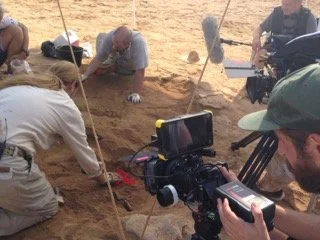
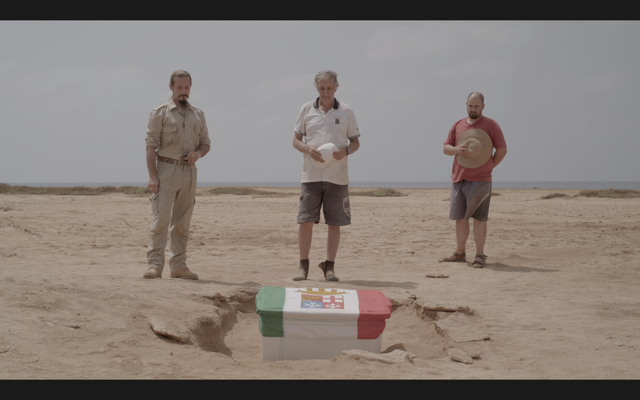
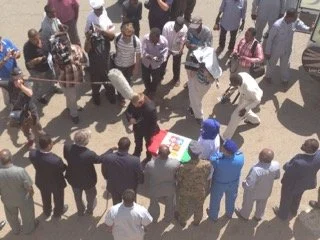
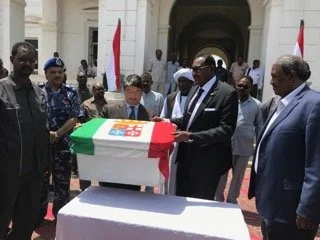
Work by SSSUK member Ricardo Preve led to the return to Italy of a submariner's remains, in a ceremony at Port Sudan on 19th April 2018. Carlo Acefalo died in 1940 on the barren Red Sea island of Barra Musa Khebir after escaping from a sinking submarine with fellow crew members (see Sudan Studies No. 53).

A moment during the excavation and filming on Barra Musa Khebir, October 2017.  Excavators are filmed by a documentary film crew.

A moment during the excavation and filming on Barra Musa Khebir, October 2017

"Tomba Carlo Acefalo" - The grave of Carlo Acefalo on Barra Musa Khebir (Sudan) with (left to right ) Dr Matteo Borrini (forensic anthropologist), Ricardo Preve (expedition leader and producer of the documentary "Coming Home"), Dr Cosimo Giachetti (archeologist). The remains are in the box in the foreground, covered by the flag of the Italian Navy.

Preve and Borrini turning over the remains of Carlo Acefalo to the Red Sea State.  The box containing the remains is draped with the flag of the Italian Navy.

Turning over the remains of Carlo Acefalo to the Red Sea State. Preve and Borrini at the hand over of the remains to the Governor of the Red Sea State on October 9, 2017, Port Sudan.

Italian Ambassador in Sudan Fabrizio Lobasso receives the remains of Italian sailor Carlo Acefalo (d. 1940) from the Red Sea State Governor at a ceremony in Port Sudan, April 19, 2018.

Italian Ambassador in Sudan Fabrizio Lobasso receives the remains of Italian sailor Carlo Acefalo, who died on the island of Barra Musa Khebir in the wreck of the submarine "Macalle" in 1940, from the Red Sea State Governor at a ceremony in Port Sudan, April 19, 2018. Society member Ricardo Preve led the 4-year process of identifying and recovering the remains.

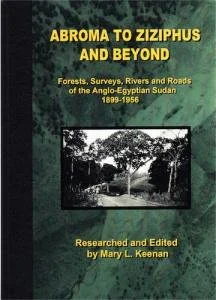
'Abroma to Ziziphus and Beyond' by Mary L. Keenan

SSSUK Secretary

Front cover of 'Abroma to Ziziphus and Beyond' by Mary L. Keenan

SSSUK member Mary Keenan's new book is now out: Abroma to Ziziphus and Beyond: Forests, Surveys, Rivers and Roads of the Anglo-Egyptian Sudan 1899-1956. Mary writes: 'The book took six years of research into hundreds of Official Documents, Government Reports, Intelligence Reports, Sudan Gazettes, Staff Lists, Forestry Reports, Expeditions, Diaries, and much more'. For further details see the flyer.

Reports on Sudan/South Sudan Seminar Series 2015/16

SSSUK Secretary

The Sudan/South Sudan Seminar Series 2015/16 was run jointly by SSSUK and the Centre for African Studies (CAS) at the School of Oriental and African Studies (SOAS), London. Reports are now available on each of the seminars:

The general flyer for the series is here.